Fruit trees explained – an introduction to the variations


Fruit trees explained – an introduction to the variations
Fruit trees are one of the most rewarding investments you can make in your garden. They provide shade, blossoms and – not least – fresh fruit that you can enjoy straight from the branch. Whether you dream of apples, cherries, plums or pears, there are a variety of types and sizes to suit different gardens and needs.
In this article, you’ll get an overview of what to look out for before planting a fruit tree, as well as an introduction to the most common types and manufacturers on the market.
The article presents a wide selection of fruit trees, illustrating the differences in varieties, growth forms and uses. The aim is to provide an informative overview of the many possibilities so that you can more easily find a tree that suits your garden and your wishes. The information about the products is based on publicly available descriptions from manufacturers and retailers and has been summarised to provide a clear and practical overview.
Factors to consider when buying fruit trees
When choosing fruit trees, it’s not just about taste – but also about space, climate and care. Here are some of the most important factors to consider.
1. Space and growth form
Fruit trees come in many sizes – from small dwarf trees that fit in pots to large trees that need a lot of space. Consider how much space you have and how quickly the tree grows. Espalier trees are ideal for small gardens or against a south-facing wall.
2. Pollination
Some fruit trees are self-pollinating, while others need a pollination partner to bear fruit. Therefore, check whether your chosen variety needs another tree nearby to achieve a good harvest. Apple and pear trees usually rely on cross-pollination.
3. Soil and location
Most fruit trees thrive best in well-drained soil and sunny locations. Avoid hollows where water can collect, and make sure the soil is not too heavy. A good start with proper planting and soil improvement increases the chances of a healthy tree.
4. Care and pruning
Regular pruning is important to ensure good fruiting and harmonious growth. Some varieties require more care than others, so choose a tree that matches the amount of time you want to invest.
5. Ripening time and taste
Fruit trees differ both in ripening time and flavour profile. If you plant several varieties, you can extend the harvest season from early summer to late autumn. Also consider whether the fruit will mainly be eaten fresh, used for baking or for preserving.
Products in focus
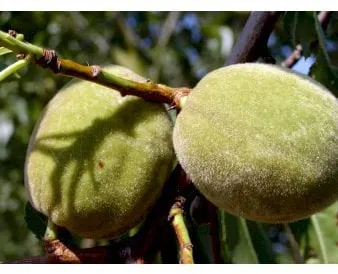
The Sweet Almond (Prunus dulcis) is a fruit tree that blooms with light pink flowers in April, giving the garden a distinct spring feeling. The fruits initially resemble small green peaches, but the flesh is dry and inedible. The kernel in the centre of the fruit is an edible almond that can be used directly or in baked goods.
The tree thrives best in full sun and in nutrient-rich soil. It should be watered and fertilised regularly during the growing season to ensure good growth and fruit production. Due to the Danish climate, cultivation in a greenhouse or in a warm location, for example against a south- or west-facing wall, is recommended to protect it from frost and fungal diseases.
The Sweet Almond has a broad-crowned growth form and can reach a height of 2–4 metres and a width of 3–4 metres. The leaves are elongated and green, and the flowers are white to light pink. The fruits usually ripen in September.
- Blossom: Light pink flowers in April provide a beautiful spring display.
- Edible almonds: The kernel of the fruit can be used like regular almonds.
- Location: Thrives best in full sun and sheltered from wind and frost.
- Growth form: Broad-crowned tree with medium growth rate.
- Use: Suitable for gardens and parks as an ornamental and useful plant.
Pros and cons
- Decorative blossom in spring
- Produces edible almonds
- Can be grown in a greenhouse or protected outdoor area
- Suitable for sunny locations
- Sensitive to frost and fungal diseases in open areas
- Requires nutrient-rich soil and regular watering
- The fruit flesh is dry and inedible
Pros and cons
Pros
- Decorative blossom in spring
- Produces edible almonds
- Can be grown in a greenhouse or protected outdoor area
- Suitable for sunny locations
Cons
- Sensitive to frost and fungal diseases in open areas
- Requires nutrient-rich soil and regular watering
- The fruit flesh is dry and inedible
Pros
- Decorative blossom in spring
- Produces edible almonds
- Can be grown in a greenhouse or protected outdoor area
- Suitable for sunny locations
Cons
- Sensitive to frost and fungal diseases in open areas
- Requires nutrient-rich soil and regular watering
- The fruit flesh is dry and inedible
Specifications
- Botanical name: Prunus dulcis
- Category: Fruit trees & fruit bushes
- Type: Almond tree
- Flowering period: April (spring)
- Flower colour: White to light pink
- Leaf colour: Green
- Leaf shape: Elongated
- Fruit colour: Brown
- Fruit size: 1–5 cm
- Ripening time: September
- Height: 200–400 cm
- Width: 300–400 cm
- Location: Full sun
- Growth form: Broad-crowned, medium-growing
- Winter hardiness: Moderate (requires frost protection)
- Fertilisation level: Medium
- Optimal growing conditions: Nutrient-rich soil and even watering
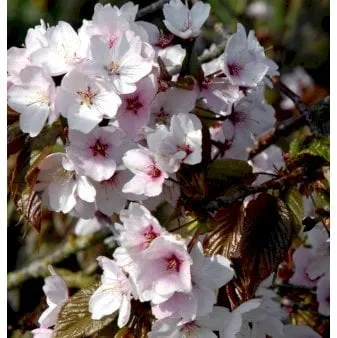
The Sakhalin Cherry, also known as Prunus sargentii, is a medium-sized deciduous tree that develops a broad, vase-shaped crown. As it matures, the tree takes on a more spreading and multi-stemmed structure, giving it a distinctive and natural appearance in the garden.
The leaves are medium-sized and elongated with a distinct tip. They emerge in a dark bronze-red tone, later turning fresh green and ending the season with intense red and orange-red autumn colours. The smooth, reddish-brown bark with light lenticels darkens over time and shows distinctive horizontal stripes.
The tree blooms profusely in April and early May with large, light pink flowers that often appear before the leaves. Fruit formation is rare, but small black-red berries can be observed in some years.
The Sakhalin Cherry thrives best in sun to partial shade and prefers a nutrient-rich, well-drained soil. It tolerates many soil types but should not be planted in areas with standing water. On heavy clay soil, the ground can be loosened and improved with gravel or sand for better drainage.
The tree is suitable as a specimen plant in gardens, parks, and avenues, where it can be highlighted as a decorative element. During the establishment phase, staking is recommended to ensure stable growth.
- Profusely flowering spring tree: Large, light pink blossoms in April and May.
- Decorative foliage: Changes from bronze-red spring foliage to red and orange-red autumn colours.
- Characteristic growth form: Vase-shaped and later broad-crowned structure.
- Robust and adaptable: Thrives in sun or partial shade on well-drained soil.
- Suitable as an ornamental tree: Ideal as a specimen tree in gardens and parks.
Pros and cons
- Beautiful blossom and striking autumn colouration
- Tolerates many soil types
- Suitable as a specimen tree or in groups
- Relatively hardy and robust
- Requires well-drained soil and should not stand in waterlogged soil
- Needs staking during the establishment phase
- Fruit formation is rare
Pros and cons
Pros
- Beautiful blossom and striking autumn colouration
- Tolerates many soil types
- Suitable as a specimen tree or in groups
- Relatively hardy and robust
Cons
- Requires well-drained soil and should not stand in waterlogged soil
- Needs staking during the establishment phase
- Fruit formation is rare
Pros
- Beautiful blossom and striking autumn colouration
- Tolerates many soil types
- Suitable as a specimen tree or in groups
- Relatively hardy and robust
Cons
- Requires well-drained soil and should not stand in waterlogged soil
- Needs staking during the establishment phase
- Fruit formation is rare
Specifications
- Botanical name: Prunus sargentii
- Common name: Sakhalin Cherry
- Category: Japanese Cherry / Tree
- Growth form: Vase-shaped, broad-crowned
- Height: 1000–1500 cm
- Width: 150–300 cm
- Flowering period: April–May
- Flower colour: Light pink to pink
- Leaf colour: Red-green, bronze-red when emerging
- Autumn colouration: Red and orange-red
- Location: Full sun or partial shade
- Soil type: Nutrient-rich and well-drained garden soil
- Winter hardiness: Fully hardy
- Use: Gardens and parks
- Wind conditions: Should be planted in a sheltered location
- Fertilisation level: Medium
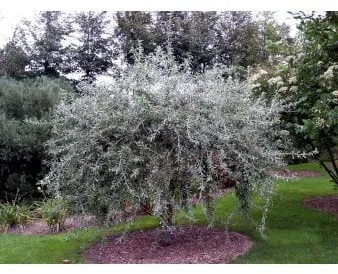
The willow-leaved pear 'Pendula' is a small tree characterised by its weeping and spreading crown. It is often grafted onto a stem, resulting in a clear trunk height and a crown that develops from round to umbrella-shaped and later roof-shaped.
The leaves are narrow and covered with fine, soft hairs that give them a silvery-grey tone in spring and later a grey-green colour. The foliage resembles that of willow or olive trees, contributing to a light and elegant appearance. In autumn, the leaves take on subtle light yellow tones, and leaf fall occurs late in the season.
The bark is initially silver-white due to the many fine hairs but becomes grey and fissured with age. In April and May, the tree blooms with white to cream-white flowers with reddish stamens, arranged in clusters and having a slightly sweet scent.
After flowering, small green-brown fruits may form, which are not edible but are sometimes eaten by birds after frost. The tree thrives best in full sun and in normal, well-drained garden soil. It is hardy, wind-resistant, and drought-tolerant once established.
The willow-leaved pear is often used as a specimen tree or in small groups, where its light foliage and weeping habit create contrast and structure in the planting.
- Weeping growth form: Creates an elegant and distinctive appearance in the garden.
- Silvery-grey foliage: Provides a light and contrasting accent against darker vegetation.
- Hardy and wind-resistant: Suitable for British climate conditions and requires minimal maintenance.
- Spring flowering: White to cream-white flowers in April–May.
- Suitable as an ornamental tree: Ideal as a specimen tree or in smaller groups.
Pros and cons
- Decorative weeping habit and silvery-green foliage
- Hardy and drought-tolerant once established
- Requires little maintenance
- Thrives in full sun and normal garden soil
- The fruits are not edible
- Young trees may need support in the first few years
- Prefers well-drained soil and may not thrive in heavy, wet soil
Pros and cons
Pros
- Decorative weeping habit and silvery-green foliage
- Hardy and drought-tolerant once established
- Requires little maintenance
- Thrives in full sun and normal garden soil
Cons
- The fruits are not edible
- Young trees may need support in the first few years
- Prefers well-drained soil and may not thrive in heavy, wet soil
Pros
- Decorative weeping habit and silvery-green foliage
- Hardy and drought-tolerant once established
- Requires little maintenance
- Thrives in full sun and normal garden soil
Cons
- The fruits are not edible
- Young trees may need support in the first few years
- Prefers well-drained soil and may not thrive in heavy, wet soil
Specifications
- Botanical name: Pyrus salicifolia 'Pendula'
- Type: Ornamental tree
- Growth form: Weeping, overhanging, broad-crowned
- Height: 400–700 cm
- Width: 300–600 cm
- Leaf colour: Grey to grey-green
- Flower colour: White to cream-white
- Flowering period: April–May
- Fruit colour: Green-brown (not edible)
- Location: Full sun
- Soil type: Nutrient-rich, well-drained garden soil
- Hardiness: Fully hardy
- Wind conditions: Should be planted in a sheltered position
- Use: Gardens and parks
- Growth: Moderately vigorous
- Ripening period: September–October
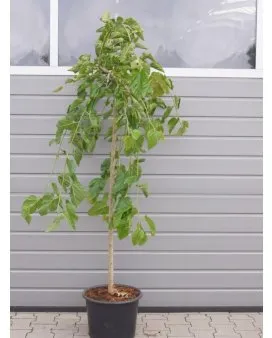
The Weeping Mulberry, botanically known as Morus alba 'Pendula', is an ornamental tree with a characteristic weeping growth form. The tree develops a broad crown with drooping branches, giving it an elegant and tranquil appearance in the garden.
The leaves are heart-shaped and dark green, creating a dense and decorative foliage mass in summer. In May and June, the tree blooms with small white flowers, which may later be followed by light, white fruits in late summer.
The tree thrives best in full sun and in normal, nutrient-rich garden soil. It grows moderately and typically reaches a height of about 3 metres and a width of approximately 2 metres, making it suitable for medium-sized gardens or as a specimen tree in parks.
The Weeping Mulberry is moderately hardy and requires only limited maintenance, making it a practical choice for garden owners who want a decorative tree with a natural, weeping expression.
- Weeping growth form: Creates an elegant and distinctive appearance in the garden.
- Bloom in May–June: Small white flowers provide a light and summery feel.
- Fruits: White mulberries that ripen in late summer.
- Location: Thrives best in full sun and nutrient-rich garden soil.
- Size: Approx. 3 metres high and 2 metres wide – suitable for medium-sized gardens.
Pros and cons
- Decorative weeping growth form
- Suitable for sunny locations
- Relatively easy to maintain
- Produces both flowers and fruits
- Moderately hardy – may require protection in severe winters
- Needs space to develop its broad crown
Pros and cons
Pros
- Decorative weeping growth form
- Suitable for sunny locations
- Relatively easy to maintain
- Produces both flowers and fruits
Cons
- Moderately hardy – may require protection in severe winters
- Needs space to develop its broad crown
Pros
- Decorative weeping growth form
- Suitable for sunny locations
- Relatively easy to maintain
- Produces both flowers and fruits
Cons
- Moderately hardy – may require protection in severe winters
- Needs space to develop its broad crown
Specifications
- Botanical name: Morus alba 'Pendula'
- Type: Fruit tree / Ornamental tree
- Size: Medium
- Height: Approx. 3 metres
- Width: Approx. 2 metres
- Leaf shape: Heart-shaped
- Leaf colour: Dark green
- Flower colour: White
- Flowering period: May – June
- Fruit colour: White
- Growth form: Broad-crowned, weeping
- Growth: Moderately growing
- Location: Full sun
- Soil type: Normal, nutrient-rich garden soil
- Winter hardiness: Medium
- Fertilisation level: Medium
- Use: Gardens and parks
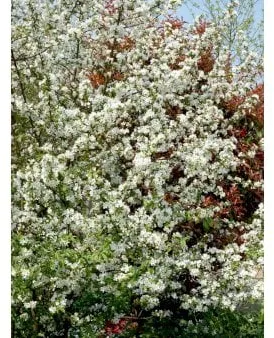
The Common Wild Apple (Malus sylvestris) is a moderately growing tree with a naturally spreading and broad crown. The species is native to Denmark and is characterised by its great resilience and ability to thrive in many soil types, even where the soil is occasionally moist.
The leaves are small, oval, and fresh green with light yellow autumn colours. Young shoots are brown-green, while older trunks develop grey-brown, scaly bark that can flake off in small pieces.
In spring, the tree is covered with many small white to pink blossoms that attract beneficial insects. Later, small, oval yellow-green fruits of 3–4 cm develop, which have a tart taste. The fruits can be used for jelly or jam and serve as food for birds during the winter months.
The tree thrives best in full sun or partial shade and requires no special growing conditions. It can be planted individually, in groups, or as part of a hedge, where its wind resistance and natural form stand out. When planting, it is recommended to use support during the first two seasons to ensure good establishment.
- Native species: Occurs naturally in Denmark and is adapted to local conditions.
- Decorative blossom: Many small white to pink blossoms in spring.
- Edible fruits: Small yellow-green apples, suitable for jelly and jam.
- High resilience: Tolerates wind and various soil types, including moist soils.
- Ecological value: Attracts insects and provides food for birds.
Pros and cons
- Robust and wind-resistant tree, suitable for Danish conditions
- Attracts pollinators and birds
- Decorative blossom and autumn colouring
- Can be used both as an ornamental tree and in hedges
- The fruits are sour and not suitable for fresh consumption
- Requires support during the establishment phase for stable growth
Pros and cons
Pros
- Robust and wind-resistant tree, suitable for Danish conditions
- Attracts pollinators and birds
- Decorative blossom and autumn colouring
- Can be used both as an ornamental tree and in hedges
Cons
- The fruits are sour and not suitable for fresh consumption
- Requires support during the establishment phase for stable growth
Pros
- Robust and wind-resistant tree, suitable for Danish conditions
- Attracts pollinators and birds
- Decorative blossom and autumn colouring
- Can be used both as an ornamental tree and in hedges
Cons
- The fruits are sour and not suitable for fresh consumption
- Requires support during the establishment phase for stable growth
Specifications
- Botanical name: Malus sylvestris
- Category: Ornamental apple
- Main category: Trees
- Growth form: Broad-crowned
- Growth: Moderate to strong
- Height: 600–700 cm
- Width: 300–400 cm
- Flowering period: April–May
- Flower colour: White to pink
- Leaf colour: Green, yellow autumn foliage
- Fruit colour: Yellow-green
- Fruit size: 3–4 cm
- Location: Full sun or partial shade
- Winter hardiness: Fully hardy
- Soil type: Nutrient-rich, well-drained garden soil; tolerates moist soils
- Use: Gardens, parks, hedges
Product descriptions
The Sweet Almond (Prunus dulcis) is a fruit tree that blooms with light pink flowers in April, giving the garden a distinct spring feeling. The fruits initially resemble small green peaches, but the flesh is dry and inedible. The kernel in the centre of the fruit is an edible almond that can be used directly or in baked goods.
The tree thrives best in full sun and in nutrient-rich soil. It should be watered and fertilised regularly during the growing season to ensure good growth and fruit production. Due to the Danish climate, cultivation in a greenhouse or in a warm location, for example against a south- or west-facing wall, is recommended to protect it from frost and fungal diseases.
The Sweet Almond has a broad-crowned growth form and can reach a height of 2–4 metres and a width of 3–4 metres. The leaves are elongated and green, and the flowers are white to light pink. The fruits usually ripen in September.
- Blossom: Light pink flowers in April provide a beautiful spring display.
- Edible almonds: The kernel of the fruit can be used like regular almonds.
- Location: Thrives best in full sun and sheltered from wind and frost.
- Growth form: Broad-crowned tree with medium growth rate.
- Use: Suitable for gardens and parks as an ornamental and useful plant.
Pros and cons
- Decorative blossom in spring
- Produces edible almonds
- Can be grown in a greenhouse or protected outdoor area
- Suitable for sunny locations
- Sensitive to frost and fungal diseases in open areas
- Requires nutrient-rich soil and regular watering
- The fruit flesh is dry and inedible
Pros and cons
Pros
- Decorative blossom in spring
- Produces edible almonds
- Can be grown in a greenhouse or protected outdoor area
- Suitable for sunny locations
Cons
- Sensitive to frost and fungal diseases in open areas
- Requires nutrient-rich soil and regular watering
- The fruit flesh is dry and inedible
Pros
- Decorative blossom in spring
- Produces edible almonds
- Can be grown in a greenhouse or protected outdoor area
- Suitable for sunny locations
Cons
- Sensitive to frost and fungal diseases in open areas
- Requires nutrient-rich soil and regular watering
- The fruit flesh is dry and inedible
Specifications
- Botanical name: Prunus dulcis
- Category: Fruit trees & fruit bushes
- Type: Almond tree
- Flowering period: April (spring)
- Flower colour: White to light pink
- Leaf colour: Green
- Leaf shape: Elongated
- Fruit colour: Brown
- Fruit size: 1–5 cm
- Ripening time: September
- Height: 200–400 cm
- Width: 300–400 cm
- Location: Full sun
- Growth form: Broad-crowned, medium-growing
- Winter hardiness: Moderate (requires frost protection)
- Fertilisation level: Medium
- Optimal growing conditions: Nutrient-rich soil and even watering
The Sakhalin Cherry, also known as Prunus sargentii, is a medium-sized deciduous tree that develops a broad, vase-shaped crown. As it matures, the tree takes on a more spreading and multi-stemmed structure, giving it a distinctive and natural appearance in the garden.
The leaves are medium-sized and elongated with a distinct tip. They emerge in a dark bronze-red tone, later turning fresh green and ending the season with intense red and orange-red autumn colours. The smooth, reddish-brown bark with light lenticels darkens over time and shows distinctive horizontal stripes.
The tree blooms profusely in April and early May with large, light pink flowers that often appear before the leaves. Fruit formation is rare, but small black-red berries can be observed in some years.
The Sakhalin Cherry thrives best in sun to partial shade and prefers a nutrient-rich, well-drained soil. It tolerates many soil types but should not be planted in areas with standing water. On heavy clay soil, the ground can be loosened and improved with gravel or sand for better drainage.
The tree is suitable as a specimen plant in gardens, parks, and avenues, where it can be highlighted as a decorative element. During the establishment phase, staking is recommended to ensure stable growth.
- Profusely flowering spring tree: Large, light pink blossoms in April and May.
- Decorative foliage: Changes from bronze-red spring foliage to red and orange-red autumn colours.
- Characteristic growth form: Vase-shaped and later broad-crowned structure.
- Robust and adaptable: Thrives in sun or partial shade on well-drained soil.
- Suitable as an ornamental tree: Ideal as a specimen tree in gardens and parks.
Pros and cons
- Beautiful blossom and striking autumn colouration
- Tolerates many soil types
- Suitable as a specimen tree or in groups
- Relatively hardy and robust
- Requires well-drained soil and should not stand in waterlogged soil
- Needs staking during the establishment phase
- Fruit formation is rare
Pros and cons
Pros
- Beautiful blossom and striking autumn colouration
- Tolerates many soil types
- Suitable as a specimen tree or in groups
- Relatively hardy and robust
Cons
- Requires well-drained soil and should not stand in waterlogged soil
- Needs staking during the establishment phase
- Fruit formation is rare
Pros
- Beautiful blossom and striking autumn colouration
- Tolerates many soil types
- Suitable as a specimen tree or in groups
- Relatively hardy and robust
Cons
- Requires well-drained soil and should not stand in waterlogged soil
- Needs staking during the establishment phase
- Fruit formation is rare
Specifications
- Botanical name: Prunus sargentii
- Common name: Sakhalin Cherry
- Category: Japanese Cherry / Tree
- Growth form: Vase-shaped, broad-crowned
- Height: 1000–1500 cm
- Width: 150–300 cm
- Flowering period: April–May
- Flower colour: Light pink to pink
- Leaf colour: Red-green, bronze-red when emerging
- Autumn colouration: Red and orange-red
- Location: Full sun or partial shade
- Soil type: Nutrient-rich and well-drained garden soil
- Winter hardiness: Fully hardy
- Use: Gardens and parks
- Wind conditions: Should be planted in a sheltered location
- Fertilisation level: Medium
The willow-leaved pear 'Pendula' is a small tree characterised by its weeping and spreading crown. It is often grafted onto a stem, resulting in a clear trunk height and a crown that develops from round to umbrella-shaped and later roof-shaped.
The leaves are narrow and covered with fine, soft hairs that give them a silvery-grey tone in spring and later a grey-green colour. The foliage resembles that of willow or olive trees, contributing to a light and elegant appearance. In autumn, the leaves take on subtle light yellow tones, and leaf fall occurs late in the season.
The bark is initially silver-white due to the many fine hairs but becomes grey and fissured with age. In April and May, the tree blooms with white to cream-white flowers with reddish stamens, arranged in clusters and having a slightly sweet scent.
After flowering, small green-brown fruits may form, which are not edible but are sometimes eaten by birds after frost. The tree thrives best in full sun and in normal, well-drained garden soil. It is hardy, wind-resistant, and drought-tolerant once established.
The willow-leaved pear is often used as a specimen tree or in small groups, where its light foliage and weeping habit create contrast and structure in the planting.
- Weeping growth form: Creates an elegant and distinctive appearance in the garden.
- Silvery-grey foliage: Provides a light and contrasting accent against darker vegetation.
- Hardy and wind-resistant: Suitable for British climate conditions and requires minimal maintenance.
- Spring flowering: White to cream-white flowers in April–May.
- Suitable as an ornamental tree: Ideal as a specimen tree or in smaller groups.
Pros and cons
- Decorative weeping habit and silvery-green foliage
- Hardy and drought-tolerant once established
- Requires little maintenance
- Thrives in full sun and normal garden soil
- The fruits are not edible
- Young trees may need support in the first few years
- Prefers well-drained soil and may not thrive in heavy, wet soil
Pros and cons
Pros
- Decorative weeping habit and silvery-green foliage
- Hardy and drought-tolerant once established
- Requires little maintenance
- Thrives in full sun and normal garden soil
Cons
- The fruits are not edible
- Young trees may need support in the first few years
- Prefers well-drained soil and may not thrive in heavy, wet soil
Pros
- Decorative weeping habit and silvery-green foliage
- Hardy and drought-tolerant once established
- Requires little maintenance
- Thrives in full sun and normal garden soil
Cons
- The fruits are not edible
- Young trees may need support in the first few years
- Prefers well-drained soil and may not thrive in heavy, wet soil
Specifications
- Botanical name: Pyrus salicifolia 'Pendula'
- Type: Ornamental tree
- Growth form: Weeping, overhanging, broad-crowned
- Height: 400–700 cm
- Width: 300–600 cm
- Leaf colour: Grey to grey-green
- Flower colour: White to cream-white
- Flowering period: April–May
- Fruit colour: Green-brown (not edible)
- Location: Full sun
- Soil type: Nutrient-rich, well-drained garden soil
- Hardiness: Fully hardy
- Wind conditions: Should be planted in a sheltered position
- Use: Gardens and parks
- Growth: Moderately vigorous
- Ripening period: September–October
The Weeping Mulberry, botanically known as Morus alba 'Pendula', is an ornamental tree with a characteristic weeping growth form. The tree develops a broad crown with drooping branches, giving it an elegant and tranquil appearance in the garden.
The leaves are heart-shaped and dark green, creating a dense and decorative foliage mass in summer. In May and June, the tree blooms with small white flowers, which may later be followed by light, white fruits in late summer.
The tree thrives best in full sun and in normal, nutrient-rich garden soil. It grows moderately and typically reaches a height of about 3 metres and a width of approximately 2 metres, making it suitable for medium-sized gardens or as a specimen tree in parks.
The Weeping Mulberry is moderately hardy and requires only limited maintenance, making it a practical choice for garden owners who want a decorative tree with a natural, weeping expression.
- Weeping growth form: Creates an elegant and distinctive appearance in the garden.
- Bloom in May–June: Small white flowers provide a light and summery feel.
- Fruits: White mulberries that ripen in late summer.
- Location: Thrives best in full sun and nutrient-rich garden soil.
- Size: Approx. 3 metres high and 2 metres wide – suitable for medium-sized gardens.
Pros and cons
- Decorative weeping growth form
- Suitable for sunny locations
- Relatively easy to maintain
- Produces both flowers and fruits
- Moderately hardy – may require protection in severe winters
- Needs space to develop its broad crown
Pros and cons
Pros
- Decorative weeping growth form
- Suitable for sunny locations
- Relatively easy to maintain
- Produces both flowers and fruits
Cons
- Moderately hardy – may require protection in severe winters
- Needs space to develop its broad crown
Pros
- Decorative weeping growth form
- Suitable for sunny locations
- Relatively easy to maintain
- Produces both flowers and fruits
Cons
- Moderately hardy – may require protection in severe winters
- Needs space to develop its broad crown
Specifications
- Botanical name: Morus alba 'Pendula'
- Type: Fruit tree / Ornamental tree
- Size: Medium
- Height: Approx. 3 metres
- Width: Approx. 2 metres
- Leaf shape: Heart-shaped
- Leaf colour: Dark green
- Flower colour: White
- Flowering period: May – June
- Fruit colour: White
- Growth form: Broad-crowned, weeping
- Growth: Moderately growing
- Location: Full sun
- Soil type: Normal, nutrient-rich garden soil
- Winter hardiness: Medium
- Fertilisation level: Medium
- Use: Gardens and parks
The Common Wild Apple (Malus sylvestris) is a moderately growing tree with a naturally spreading and broad crown. The species is native to Denmark and is characterised by its great resilience and ability to thrive in many soil types, even where the soil is occasionally moist.
The leaves are small, oval, and fresh green with light yellow autumn colours. Young shoots are brown-green, while older trunks develop grey-brown, scaly bark that can flake off in small pieces.
In spring, the tree is covered with many small white to pink blossoms that attract beneficial insects. Later, small, oval yellow-green fruits of 3–4 cm develop, which have a tart taste. The fruits can be used for jelly or jam and serve as food for birds during the winter months.
The tree thrives best in full sun or partial shade and requires no special growing conditions. It can be planted individually, in groups, or as part of a hedge, where its wind resistance and natural form stand out. When planting, it is recommended to use support during the first two seasons to ensure good establishment.
- Native species: Occurs naturally in Denmark and is adapted to local conditions.
- Decorative blossom: Many small white to pink blossoms in spring.
- Edible fruits: Small yellow-green apples, suitable for jelly and jam.
- High resilience: Tolerates wind and various soil types, including moist soils.
- Ecological value: Attracts insects and provides food for birds.
Pros and cons
- Robust and wind-resistant tree, suitable for Danish conditions
- Attracts pollinators and birds
- Decorative blossom and autumn colouring
- Can be used both as an ornamental tree and in hedges
- The fruits are sour and not suitable for fresh consumption
- Requires support during the establishment phase for stable growth
Pros and cons
Pros
- Robust and wind-resistant tree, suitable for Danish conditions
- Attracts pollinators and birds
- Decorative blossom and autumn colouring
- Can be used both as an ornamental tree and in hedges
Cons
- The fruits are sour and not suitable for fresh consumption
- Requires support during the establishment phase for stable growth
Pros
- Robust and wind-resistant tree, suitable for Danish conditions
- Attracts pollinators and birds
- Decorative blossom and autumn colouring
- Can be used both as an ornamental tree and in hedges
Cons
- The fruits are sour and not suitable for fresh consumption
- Requires support during the establishment phase for stable growth
Specifications
- Botanical name: Malus sylvestris
- Category: Ornamental apple
- Main category: Trees
- Growth form: Broad-crowned
- Growth: Moderate to strong
- Height: 600–700 cm
- Width: 300–400 cm
- Flowering period: April–May
- Flower colour: White to pink
- Leaf colour: Green, yellow autumn foliage
- Fruit colour: Yellow-green
- Fruit size: 3–4 cm
- Location: Full sun or partial shade
- Winter hardiness: Fully hardy
- Soil type: Nutrient-rich, well-drained garden soil; tolerates moist soils
- Use: Gardens, parks, hedges
Different types of fruit trees
Fruit trees come in many varieties, and the choice depends on taste, climate and space. Here are some of the most common types you can consider for your garden.
1. Apple trees
The apple tree is the most popular fruit tree in Denmark. There are countless varieties – from early summer apples to late winter apples. They are hardy and adapt well to the Danish climate.
2. Pear trees
Pear trees thrive best in warm and sunny locations. They often need a pollination partner but reward you with juicy, sweet fruit. Pears are suitable for both fresh eating and preserving.
3. Plum trees
Plums are easy to grow and produce abundant harvests. They come in many colours and flavours – from tart to very sweet. Some varieties are self-pollinating, which makes them easy to establish.
4. Cherry trees
Cherry trees offer both beautiful spring blossoms and delicious fruit. Sweet cherries need warmth and sun, while sour cherries are hardier and well suited for preserving and baking.
5. Peach and nectarine trees
These trees thrive best in sheltered, sunny corners or in a greenhouse. They require a bit more care but reward you with exotic fruit that can also be grown in British gardens with the right microclimate.
Different brands of fruit trees
There are many producers and nurseries that offer high-quality fruit trees. Here are some of the best-known suppliers on the market.
Jespers Planteskole
A Danish brand focusing on quality and a wide selection of fruit trees for both private individuals and professionals. They offer many varieties that are particularly suitable for the Nordic climate.
Plantetorvet
Plantetorvet is one of the largest online retailers of plants and fruit trees in Denmark. They have a large range and provide detailed descriptions of growing conditions and care.
Lundhede Planteskole
Lundhede specialises in plants for gardens and parks. Their fruit trees are known for good quality and healthy growth, and they offer both classic and newer varieties.
Bakker.com
An international brand that delivers fruit trees directly to your door. The range extends from traditional varieties to more exotic types that can be grown in pots or greenhouses.
Plantorama
Plantorama combines physical retail and online sales and offers a wide selection of fruit trees, often focusing on easy establishment and care for hobby gardeners.
Frequently asked questions
When is the best time to plant fruit trees?
The best time is in autumn or early spring, when the soil is moist and the temperatures are mild. This gives the tree time to form roots before the growing season begins.
How quickly does a fruit tree bear fruit?
Most fruit trees start bearing fruit after 2–4 years, depending on the variety and growing conditions. However, dwarf trees and grafted varieties can bear fruit in the first year.
How do you prune a fruit tree correctly?
Prune in winter or early spring before the buds break. Remove dead and crossing branches and shape the crown so that light and air can penetrate. This promotes healthy growth and better fruiting.
Should you fertilise fruit trees?
Yes, but in moderation. A light fertilisation in spring helps the tree get started, while too much fertiliser can cause strong growth at the expense of fruit. Use organic fertiliser for an even nutrient supply.
Can you grow fruit trees in pots?
Yes, especially dwarf and columnar trees are well suited for pots. Make sure you have a large pot with good drainage and regular watering. Potted trees require a bit more care but are ideal for balconies and small gardens.
Læs også: